6.08.2014

june garden starts


I spend the first few weeks of my garden season fairly certain it will all fail. But then the roots begin to take, and new leaves begin to sprout, and I realize that once again, I know how to plant things. And every year something is new and something dies and something thrives.

This year, just outside the living room window, I have a bed of spinach and lettuce growing. Safe from munching bunnies.


And since the neighbor is building a house next to our back yard, our back patio isn't as inviting as it used to be. We're accommodating by making the front porch a pretty place to sit too (lots of plants and some camp chairs).  And though we have a few too many wasps buzzing around the front porch, we still find it more relaxing that sitting within view and earshot of the neighbor and his construction. 


Also outside the living room, we put in a flower bed. Though some leftover tomato and pepper plants have landed there as well. By Summer, I should be able to see blooming flowers while sitting inside on my couch. (Notice the rock wall inspired by Chaco.)


The hollyhock is already up to my chest. And last year's herbs (chives, sage, thyme & oregano) are already bigger than they ever were last year. All the garden is planted. Now we wait. And also now I have to investigate the little black bugs I'm finding on the tomatoes. 

6.01.2014

where people lived


Somewhere driving through the Santa Fe National Forest, while driving to Chaco Canyon, we drove through a tiny town named Coyote which seemed so remote, and so hard to get to, and so closed in by cliffs, that we realized there are places in this country that are truly far away from the rest of the world. Our drive took us through desert mesas, red cliffs and forests of Ponderosa pines.

This is a place we'd been talking about going to for awhile. And when the subject of "something fun for my birthday" came up...this was D's suggestion.


The Chaco Culture National Park, otherwise known as Chaco Canyon, is a shallow canyon 10 miles long  in the northwest corner of New Mexico, at least 50 miles from any town. You take the 550 highway up along the Navajo reservation, turn left at the Nageezi gas station, and spend 20 miles on a bumpy dirt road. Along the way it is flat, and wild ponies run and you pass by the occasional hogan or trailer, none of which look inhabited. And you think again about what it is like to live so far away from what you think the country is.

Chaco is considered to contain one of the most important collections of ancient ruins north of Mexico. The now-crumbling ruins were built between 900 and 1150 AD and it is believed to have been a major cultural center for the pre-Columbian peoples. Built by people we now call the Anasazi, it was likely used as a ceremonial center which people would travel to from hundreds of miles away. It isn't just one ruin, it is at least 15 "great" houses, only some of which has been excavated.


We arrived in the evening, with the wind picking up and a possible storm on the way. Our reserved camp site looked like the worst one there, but luckily, some other folks had left scared of the rain, so we got a much better site after all. From the camp site you can see La Fajada Butte, which excited both of us. We knew that beyond the Butte were the ruins, and that we'd have to wait til the next day to see them all.

La Fajada Butte towers above the canyon at 380 feet high. There are ruins of small structures on the Butte, showing that someone once lived up there. And astrological markings on the Butte show its important to the people in tracking the stars. The Navajo believe that a witch (la bruja) lived in the great house, called La Una Vida, nearest the Butte, and that she kept her prisoners trapped up high & on top.

Whether because of climate, lack of food or simply a revolt of neighboring peoples, Chaco was abandoned by its population. It now sits at the edge of the Navajo reservation ("Anasazi" is the Navajo world for "ancient enemy"), and the area is considered sacred by the Navajo, Hopi and Pueblo peoples.

Whoever built these "great" houses did so with full knowledge of how to build them in alignment with solar and lunar cycles. They understood the sun, the moon and the eclipses. Faint outlines of the North and South roads which led from Chaco to the outside world, for hundreds of miles, still exist. We could see them while standing on the mesa above the canyon. It is said you can even see them from space.


We started the morning with the hike up the mesa to the Pueblo Alto (High House), which seems to have been built with a view to the north, sort of a watch-out house for the population in the canyon below. What continually astounded us was how much you can still see. The roads which they had built, still cutting through on the south & north sides. How evident it was that this was all so designed, and built with purpose. 


One thing about the Chaco ruins that has piqued so much interest, is that the buildings were created from rock, mortar and even wood. Pueblo peoples build with adobe mud bricks, and have for the past 1,000 years, but the Chaco people, built in stone. They meant to last forever. 

Once we climbed back down (had a picnic lunch in the truck, and put on our rain jackets), we began the walks around Chetro Ketl, Pueblo del Arroyo and Pueblo Bonito. The Pueblo Bonito house is the largest, it is estimated over 1,000 people lived in the Bonito spot alone. Apartments were built three-stories high.


Most believe that  Chaco was built for ceremony, probably a combination of religion & government. A place of pilgrimage for thousands, over hundreds of years. The people that lived here all year-round were the caretakers of the buildings, the kivas, priests & leaders. The number of Kivas at Chaco is a prime reason for this belief. The "great" houses themselves were likely more than houses, they were temples and palaces. 


I'm reading a book called "The House of Rain" which is an exploration of the ancient civilizations of the Southwest. In it the author, Craig Childs, writes that the structures  of Chaco were "ceremonial buildings that once stood out like cathedrals in the  desert."


a kiva

petroglyphs


Chaco is for explorers. It is for those who relish in the mystery & stories of history. We of course are two of those people. 

We spent most of our trip in awe. Awe of the canyon, of the ruins, the trails and the petroglyphs. The magic, the ceremony, the religion and the faith that once resided here must have been powerful, because you can still feel something as you walk in the shadows of the walls that remain standing. As the author, Craig Childs writes, "something colossal happened here."

5.18.2014

middle of May


at the beginning of the week we received several inches of snow, though it all melted away by the next day. and here at the ending of the week, we spent the day in shorts and t-shirts.

mi madre y mi tia were here for two nights. I got to take them to favorite places, eat good food with them, and show them our backyard hike. it felt nice to be with two women I am so incredibly related to. 


i've been moving little plants out during the day. my basil gets lots of sun, and then comes back in at night. but the flowering sweetpeas and some of the morning glories went in the ground today. oh, how satisfying it feels to plant things. these little green bits that I put in soil to sprout back when the outside seemed so cold and Spring seemed forever away. I moved a lot of my geraniums outside today too, and then filled up my red water pitcher in the acequia, and watered them with the fresh snow water. 


 the hollyhock I planted last year has boldly returned.

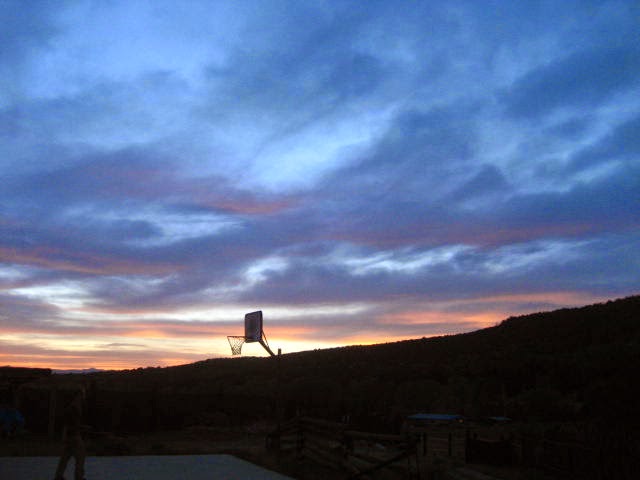
this evening the sky turned pink and purple, and D. shot some hoops as it got too dark to see. our night is closing with another viewing of Easy Rider, in honor of the Dennis Hopper-day celebrated in Taos this weekend (Hopper being one of our more infamous once-residents). and because it opens with a scene shot with a view of Taos Mountain.

next weekend we are taking a trip to Chaco Canyon. I'll have pictures.


4.27.2014

snow still


I found a job, and just had my first week. It isn't a job I was hoping for, but it is a job. And it was the first full-time job I was offered in these eight months. So it is my job now. It is for a small company, with very nice people, and it pays very little. But I have something to do. And will manage to pay the bills. 

Took two walks yesterday, one on my own in the morning. I just knew I needed some exercise & mind-clearing. I found a bush in bloom, I'm not sure what it is. And another walk later, with D., as he also felt the need for some air. The wind was strong, and it began to get colder as we neared towards home. Snow fell last night.

A slow Sunday afternoon. I baked bread and muffins. Am listening to the wind & the snow blow through the trees and over the chimney. And it might be time for a little nap. 


4.12.2014

mixing all the dirt


Another walk out in the Wild Rivers area. It seems so near us, which is why I think we keep going back. This time we took the Cebolla Mesa trail down to the Rio Grande. 


A lot of lovely Ponderosas along this trail. And it was a nice warm walk. Hats were much needed. And our long-sleeve shirts quickly ended up in D's backpack.


The rocks/boulders at the river bank have all turned black & sculpted from the years of water moving over them (thousands, hundreds, a million?) Big, solid remnants of time. 


With such smooth curves. 


We sat on one end of what was once a bridge. We divided up the granola bars (next time we are packing a lunch) and snacked in the river breeze. 


It took us about three hours, down & up. And we talked about what awesome shape we'd be in if we did this hike each week (the coming up involves a few breathers). 

This morning we bought a few things at a rummage sale and then an estate sale too. And then spent a couple hours just digging dirt, making little ditches, adding better dirt to the dirt, and then mixing all the dirt. A garden expansion is in the works (just a few little beds for onions, herbs and more flowers). We know so much more about this land than we did when moving in a year ago (about). So knowing what we can grow, and how much, we've decided to grow a little more. The greenhouse is alive right now, with seedlings from the all of us living here on this farm. 

4.07.2014

dia de nieve


Yesterday's snowy morning gave for lovely views, as the sun rose & clouds lifted out of the valley. By afternoon the snow had mostly melted into the land. I spent some time digging up dirt in the garden bed. I was pulling out weeds and planning new beds for more room to grow. Even in the cold, it felt like the right place to be. And I could hear neighbors outside doing the same.
By late afternoon, the sky clouded up and snow fell on me as I shoveled. So I headed inside to start pasta sauce to simmer on the stove awhile. (I'm down to just four jars of sauce from last summer's harvest!) 

All fog this morning. But slowly the sun is rising and it lifts.

4.05.2014

work day on the ditch

our stretch of acequia
We live next to the Acequia Llano del Madre, it feeds from the Rio Hondo. This is our "ditch" which we use to water our garden. It looks like a narrow creek with a rocky bed and willows growing along edges. But the acequia is actually a canal, dug out of this landscape, some time in the early 19th century after the Arroyo Hondo land was granted to Spanish families for settlement.

There are hundreds of these ditches in NM. Often acequia building came second only to building a community's church. When the Spanish first began to colonize NM, over 400 years ago, they recognized the irrigation practices of the native peoples, as it resembled water irrigation back home in medieval Spain. They adapted the system into their own rules, and the acequias function pretty much the same today.

a main gate, last summer

Each Spring, before the ditches are officially turned "on" (headgates are opened) all parciantes (land owners who use the ditch) are required to help in the community clean up. Everyone who uses the water, has to share in the work. And I think its one reason why people here carry such a value to their water...something not seen places where getting water means just turning on the faucet. La Agua es La Vida, so they say.

early winter snowy acequia

Though our landlord is the official parciante, we volunteered to help her work. We woke early, dressed for the cold in our wool shirts, boots and heavy work pants, threw some granola bars & water in the backpack, and carrying a shovel and hedge clippers, walked down the road to the official meeting place, the church. We stood there among our Llano del Madre neighbors of all ages. Each landowner's name was called out, names here for muy generations such as Martinez, Padilla, Chacon, Vigil, Medina, with a few scattered Anglo names (which means you've been here only a generation or two) such as Frank or Miller.

We got assigned to a crew, started at el Medio, and worked East for hours.  Digging roots, cutting willows and removing debris. All down the row, speaking Spanish or English, in polite conversation and neighborly jokes.

An older man noticed that I was stretching & rubbing my hand (it hurt), and he told me about the arthritis in his hands. And then he said, "eh, but I grew up with a shovel in my hand." He had nine brothers and they were his father's cheap labor. An older little lady, (who'd been sure to put on her rouge & lipstick for the work day) took D's shovel from him twice just to show him how to do his task a little better. She told us she grew seven acres of orchards & alfalfa. And lamented how all the city people have no idea where their food comes from, or how hard it is to grow.

I understood 1/64 of the Spanish I heard today. Or maybe less than that. New words regarding acequias learned: sangrias, presas, desague y compuertas.

summer acequia walk

We worked half the day, and left feeling tired and a little sore. But feeling accomplished too. We took part in something that has meaning for this place. And when the water starts to flow, we'll feel a little more like we actually deserve to use it.

4.02.2014

more starts


D. did a lot of searching, and then one day he drove the old truck up to Colorado, and drove home in a newer deal. So, we have a truck again--and a good-looking, reliable truck with all his wants, so that has been a happy thing. 

I've been going out to the garden plot, and basically just hanging out. I pull out weeds from time to time, but that's all I can do. I check on the little green bits of the sage, thyme & oregano popping up, and they are always just fine. So are the hollyhocks. The warming sun and the green grass popping up all over the place has given me some garden fever (and is giving the cat Spring Fever...in which she just spends her days plotting how to sneakily run outside.)


We dug up a little plot just by the house. This is where I'll throw flower seeds. The idea is that I'll have flowers to look at outside my windows. This will be a very happy thing.

We fashioned (well, not We really, it was D. who did all the fashioning) up a cold frame. I've planted some lettuce & spinach. This an experiment, but if it works, I'll have salad greens just outside my windows too. 

The best time of my week so far was spent down in the greenhouse. The landlord showed me where I could put my starts in amongst all of hers and our other neighbor. Inside the orange tree & lemon tree are blooming beautiful white & pink flowers...making a lovely scent, fully perfuming the air. Bees were happily at work, buzzing in the trees, occasionally zooming by me to see what I was up to, but always returned to their pollen opportunity. I planted dozens of starts...tomatoes, peppers, basil, cilantro, dill, marigolds, zinnias and statice. I'm sure I'll end up starting even more in a week or two. Getting seeds in dirt is always a soul satisfying experience. 


3.28.2014

Starts


A happy day is made, when you begin the starts.